
Tattooing has its own language. Words like stroke, give, hit, and hertz get thrown around all the time, but they’re not always easy to explain on the spot. That can be a problem when you’re talking to clients, helping newer artists, or just trying to fine-tune your own setup.
This glossary breaks down the most common tattoo machine terms you need to know.
If you’ve ever wanted these terms explained in a way you can actually use in real conversations, you’re in the right place.
The Words Every Client Hears, but Not All Artists Explains Well
This guide is your new practical dictionary.Each tattoo machine term is explained in simple language, so you can sharpen your knowledge, train new artists, or explain your process to clients more easily.

Machine Mechanics
Before anything else, it helps to know how your machine actually works. These terms cover the basics of what’s going on inside your machine.
- Stroke Length: Simply put, this is how far the needle moves up and down. A shorter stroke works well for soft shading, while a longer stroke gives you the extra power you need for bold lines and packing in color.
- Adjustable Stroke: This lets you change the stroke length on the same machine, so you can switch between lining and shading without having to grab a different machine. Many tattoo machines with an adjustable stroke use a stroke adjustment knob.
- Stroke Cam: A small, circular part inside a rotary machine that takes the spinning motion of the motor and turns it into the up-and-down movement of the needle.
- Hertz (Hz): A measurement of speed that tells you how many times the needle moves up and down per second.
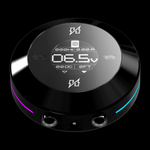
- Voltage: The amount of power going to your machine. If you turn it up and the needle moves faster, but if you turn it down, the needle slows..
- Power Connection (RCA vs. Clip Cord): This refers to how your machine gets power. Most modern machines are wireless, using built-in batteries for convenience and mobility. RCA connections are still common on many rotary machines and offer a stable, consistent power source when paired with a power supply, while clip cords are typically used with traditional coil machines.
- Rotary Machine: This type of machine uses a small motor to drive the needles. They’re popular because they’re quiet, lightweight, and give you a smooth, consistent feel.
- Coil Machine: The traditional choice. A coil machine uses electromagnetic coils and springs to move the needle, and if you have ever been near one, you know that distinct weight and buzzing sound.
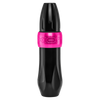
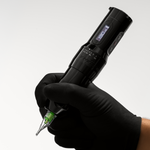
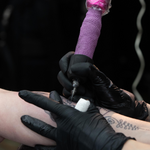
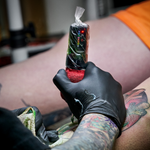
- Pen-Style Machine: A rotary machine designed to look like a pen for better precision and control.. A lot of artists love these because they feel natural in the hand and are easy to maneuver.
- Wireless Machine: Exactly what it sounds like. It runs on a detachable battery pack, so you're not stuck working around a cord.
- Direct Drive: A setup where the needle bar connects straight to the motor cam. Because there is nothing in between, you get a very powerful and consistent hit.
Machine Feel & Needle Response
Long sessions take a toll on your body, so understanding how your machine feels in your hand and against the skin really matters. These terms help you figure out what’s working for you and what might be causing unnecessary strain.
- Give: Think of this as the amount of "bounce" or cushion the machine has when the needle makes contact with the skin. Traditional coil tattoo machines have natural give. For rotary and wireless machines, this is usually built into the design or adjustable through features like springs, dampening systems, or eGive settings, allowing you to control how hard or soft the needle hits.
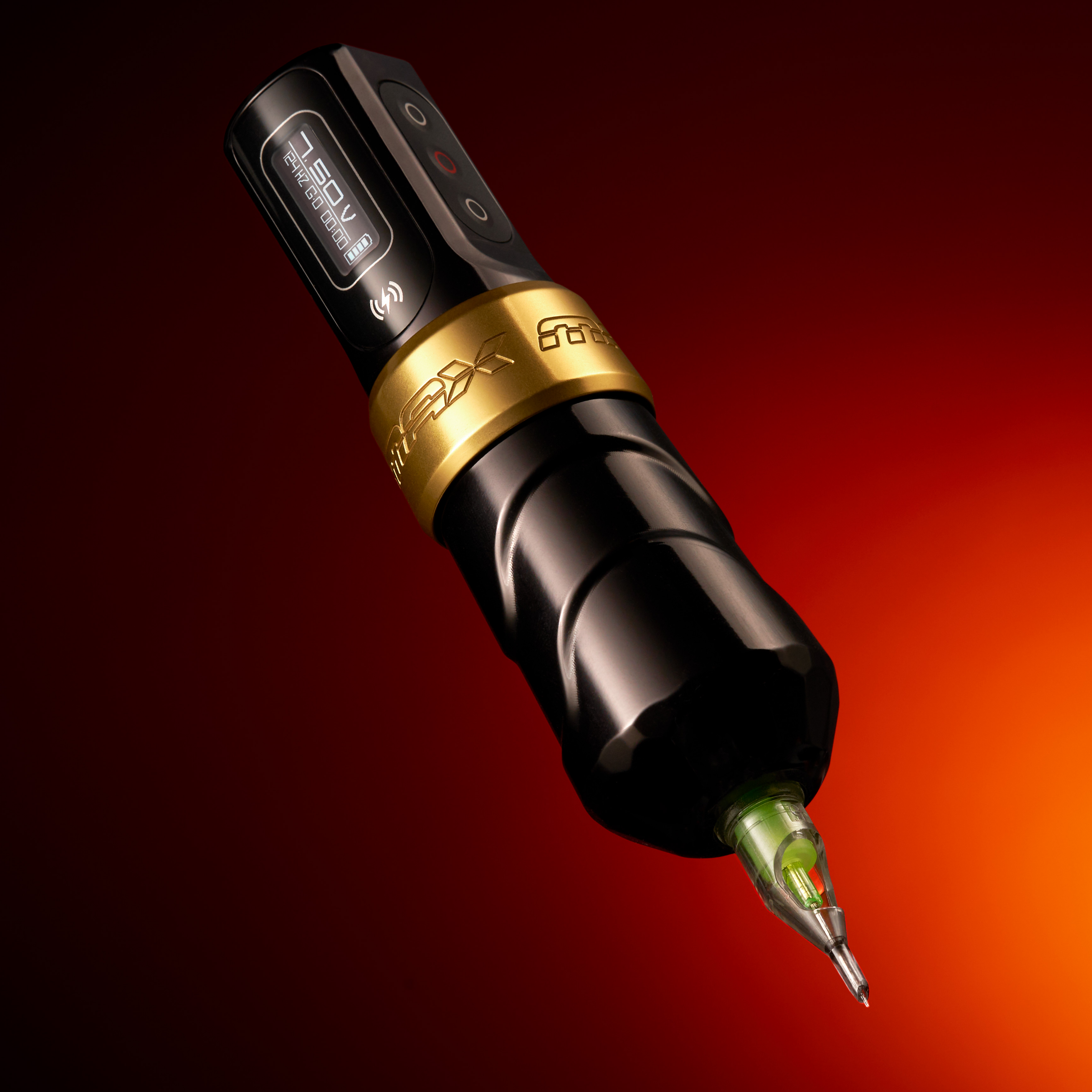
- E-Give: A digital version of give. Found in machines like the Flux Max,Opens a new window it uses technology to electronically control how hard or soft the needle hits, so you can dial it in without changing any physical parts.
- Hit: This describes the feeling and force of the needle as it enters the skin. A "hard hit" is firm, while a "soft hit" feels more cushioned.
- Vibration: The shaking your hand feels from the motor while you work. Too much of it wears you out fast, which is why machines like the Flux Max are built to keep vibration to a minimum.
- Ergonomic: A design that fits the natural shape of your hand. The goal is to reduce strain so you can work longer without your hand or wrist paying for it. Many grips are ergonomically designed so you can take on longer sessions comfortably.
- Balance: How the weight of your machine is distributed. A well-balanced machine, like the Spektra Xion RubyOpens a new window, feels steady in your hand and puts much less stress on your wrist. The physical tiredness in your hand or arm from using a machine that is too heavy or vibrates too much. Even optimized balance feels different from machine to machine. Some models are forward-weighted, and others have more centralized weight. Choosing the right balance for you comes down to preference and experimentation.

Needles and Cartridges
Choosing the right needle setup is essential for executing your vision, ensuring that every line and gradient meets your high standards for detail and accuracy.
- Traditional Needle: A long needle bar that requires a separate tube and grip to use. Use these with a traditional coil tattoo machine.
- Needle Cartridge: An all-in-one system that snaps directly into your machine; for maximum stability, we recommend using Peak CartridgesOpens a new window, which come with a 100% quality guarantee.
- Membrane: A thin seal inside the cartridge that stops ink and fluids from flowing back into your machine. It’s a small thing, but it plays a big role in keeping your equipment clean and safe.
- Needle Diameter / Gauge: The thickness of an individual needle. A smaller gauge creates a finer line, while a larger gauge is used for filling in color.
- Needle Taper: The length of the point of the needle. A "long taper" is often used for fine lines, while a "short taper" is better for packing color.
- Needle Hang: How far the needle pokes out past the tip of the cartridge while your machine is running. Getting this right directly effects your depth and control.
Needle Abbreviations Table
|
Abbreviation |
Full Name |
Use Case |
|
RL |
Round Liner |
Used for creating crisp, clean outlines. |
|
F |
Flat |
Arranged in a straight line for geometric work and blocking. |
|
Mag / M1 |
Magnum |
Two rows of needles used for shading and color packing. |
|
CM / SEM |
Curved Magnum |
A magnum with a rounded edge for smooth gradients and less skin trauma. |
|
Stacked Mag |
Stacked Magnum |
Needles grouped closer together for saturated color in tight spaces. |
|
Bugpin |
Bugpin |
Extremely thin needles used for ultra-detailed work and smooth shading. |
Techniques and Skin Application
Mastery of these terms helps you communicate the value of your work and ensures you are providing the best possible care for the skin you are transforming.
- Lining: The process of creating clean, consistent outlines using a steady hand, proper depth, and controlled machine speed. Good lining relies on precision and solid pigment saturation in a single pass.
- Packing: Filling in an area with solid, saturated color.
- Shading: Creating shadows or gradients to add depth to a design.
- Whip Shading: A shading technique where the artist moves the needle in a smooth, whipping motion, entering the skin and lifting out gradually. This creates a soft gradient that fades from dark to light.
- Saturation: How much ink the skin actually holds onto. High saturation means the color looks solid and vibrant, while low saturation can look patchy or faded.
- Depth: How far the needle goes into the skin. Too shallow and the ink will not hold, too deep and you risk blowouts and slow healing. Finding that sweet spot is everything.
- Trauma: The amount of stress or damage caused to the skin during the process. Our machines are built to cause less trauma, leading to faster healing for your clients.
- Overworked Skin: What happens when you go over the same area too many times in one session. It can lead to scarring and make the healing process much harder than it needs to be.
- Blowout: This happens when ink gets pushed too deeply into the skin, causing it to spread out and look blurry under the surface. It’s one of the most common things artists work hard to avoid.
- Drag: The resistance you feel when moving the needle across the skin. If it feels like you're pulling or fighting the skin, adjusting your lubrication or machine settings can help.
- Sterilized Water: Water that has been treated to remove all bacteria; it’s used to dilute your ink or clean the skin.
- Tattoo Gun: You'll hear clients say this all the time, but most professionals stick with "tattoo machine." It’s a small but significant distinction, reflecting the level of professionalism and care that goes into the work.
Build Your Setup With More Confidence
Knowing the terms is one thing. Trusting your setup is another. When you fully understand how stroke, give, balance, and wireless freedom affect real work, you can choose tools with more purpose and less guesswork.
Explore FK Irons tools built to support comfort, control, and modern workflow, and find the setup that fits the way you tattoo. Start with the FK ONE AdjustOpens a new window, the Flux Max Wireless Tattoo MachineOpens a new window, or the FK Irons ONEOpens a new window.