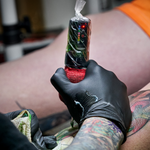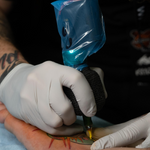

When you first start tattooing, you hear a lot of talk about voltage, needle depth, and hand speed. These are all important variables, but there's one that often stays a mystery to new artists: tattoo machine give.
If you've ever felt like your machine is "fighting" the skin or if you're struggling to get those buttery smooth gradients, give might be the missing piece. Understanding how it works helps you work longer, keep your clients more comfortable, and achieve better healing results.
What is Give in a Tattoo Machine?
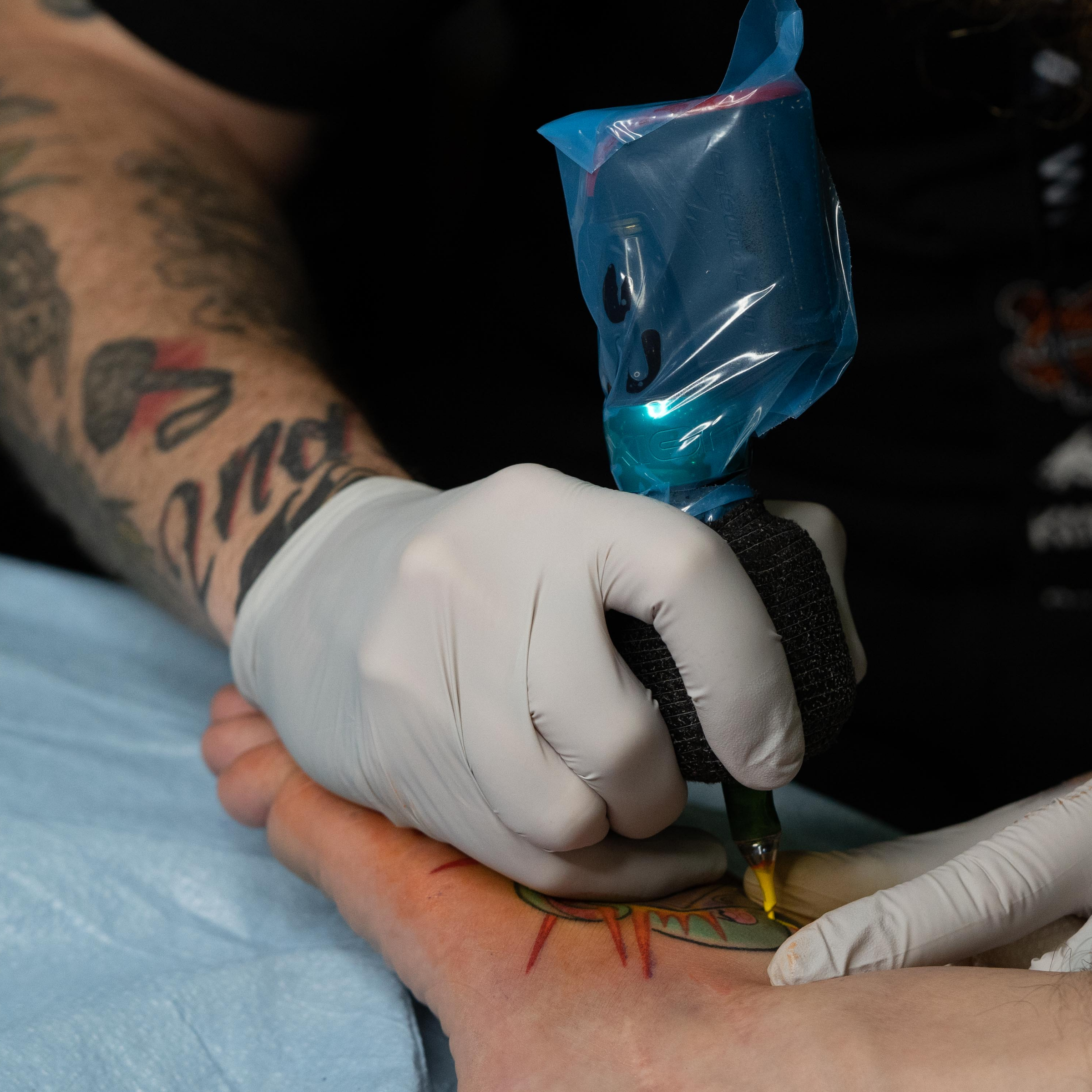
‘Give’ is how your tattoo machine responds when the needle meets resistance in the skin.” In simplest terms, it’s a recoil, and you’ll feel it as a “bounce” while you’re tattooing..
Think about how it feels when you push your needle into the skin. If a machine has zero give, it's rigid. It's going to hit exactly the same way every single time without recoil, no matter how much the skin pushes back. If a machine has lots of give, it’s more like a shock absorber. When the needle hits resistance, the machine "gives" a little bit, making the hit softer.
Why Give Matters for Your Control
Tattoo machine give is a technical spec that changes the way you feel the skin. When you have the right amount of give, the machine responds to the body. This helps you maintain consistency. If you accidentally press a little too hard, a machine with some give will soften that impact. This prevents you from going too deep or causing unnecessary damage. Overall, tattoo machine give helps prevent you from overworking the skin and causing trauma or blowouts.
It's all about responsiveness. Give allows the machine to "talk back" to your hand, telling you how much resistance the skin is offering.
Physical Give vs. E-Give

Traditionally, tattoo machine give was purely a physical attribute of a machine's construction. If you’re currently transitioning between different types of gear, understanding the fundamental differences in coil vs. rotary tattoo machinesOpens a new window is essential to mastering how each one handles skin resistance.
Coil Machines
These possess a natural, built-in give. The physical tension of the springs and the air gap between the moving parts create a mechanical cushion that reacts intuitively to the skin’s pushback.
Rotary Machines
Most rotaries are "direct drive," meaning they are naturally stiff and hit with a consistent, rigid force. To replicate the "soft" feel of a traditional setup, modern rotaries now utilize either internal mechanical springs or advanced e-give to simulate that bounce.
What is E-Give?
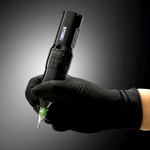
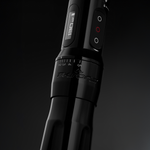
eGiveis a digital way to control how the motor behaves. Machines like our top-performing Flux MaxOpens a new window have eGive built directly into their software. You can adjust the give on the PowerBolt battery, and set it just like you would your voltage or needle depth. .
If you turn your eGive up, the motor actually slows down for a fraction of a second when it hits the skin. This mimics the softness of a coil machine. It's not "fake" tattoo machine give. It's a precise, digital tool that lets you choose exactly how hard or soft you want your machine to hit without changing any parts.
How to Use Tattoo Machine Give for Different Techniques
Because every tattoo requires a different touch, there is no single "correct" setting for your machine. Tattoo machine give is entirely situational, depending on whether you are pulling a clean line or layering a soft gradient. To gain a deeper understanding of these mechanics, explore our detailed breakdown of how machine settings affect linework, shading, and colorOpens a new window.
Below is a general guide to help you dial in your machine for the most common techniques:
|
Technique |
Give Setting |
Why it Works |
|
Linework |
Low or Off (Hard Hit) |
You want a crisp, punchy hit to get the ink in with one pass. |
|
Color Packing |
Medium |
You need enough power to saturate, but a little cushion prevents overworking. |
|
Soft Shading |
High (Soft Hit) |
This lets you layer light tones slowly without "chewing" the skin. |
Protecting the Skin and Improving Healing

One of the biggest benefits of mastering tattoo machine give is reducing skin trauma.
When a machine hits too hard on sensitive areas, like the inner arm or ribs, the skin can become red and swollen very quickly. This makes it harder for you to see your progress and much harder for the client to heal. By turning up the give (making the hit softer), you can achieve the same saturation with less damage. Your clients will have a better experience, and their tattoos will look better years down the road.
Common Beginner Mistakes
Don't fall into these two common traps:
1. The "Cloud" Trap: Too Much Give (Too Soft)
High Give + Multiple Passes = Excessive Skin Trauma
When your give is dialed up too high, the machine becomes too forgiving. While it feels gentle, the needle often lacks the necessary momentum to pierce the epidermis and reach the dermis layer where ink needs to sit.
- The Technical Failure: Because the machine "gives" away from the skin upon impact, the needle merely grazes the surface or enters at an inconsistent depth. You’ll notice the ink isn't sticking, or it looks light and patchy immediately after a pass.
- The Irony of Trauma: To compensate for the lack of saturation, beginners often make five or six passes over the same area. This leads to chewing the skin. You end up causing more inflammation and long-term damage with a "soft" machine than you would have with a single, efficient pass on a harder setting.
2. The "Hammer" Trap: No Give (Too Hard)
Zero Give + Thin Skin = High Blowout Risk
On the other side, running a machine with zero give means the needle is an immovable force. This is often the default state of direct-drive rotaries. While great for power, it leaves no room for error.
- The Technical Failure: When you hit "hard" on areas where the skin is thin—like the inner bicep, ribs, or tops of the feet—the needle can easily over-penetrate. Without any cushion to absorb your hand's downward pressure, the needle drives the ink too deep.
- The Blowout Effect: Once ink is pushed past the dermis into the fatty tissue layer, it has nowhere to go but sideways. This creates a blowout, a permanent "halo" or blurry shadow around your lines that cannot be easily fixed. On a rigid machine, a blowout can happen in a fraction of a second if your hand pressure isn't perfect.
Experiment and Find Your Preference
The best way to truly understand give is through hands-on experimentation. Start by setting your e-give or mechanical adjustment to a middle-of-the-road value. Try shading a small section, then dial the tattoo machine give all the way up to feel the immediate contrast. You may even notice a subtle shift in the machine’s pitch as the motor begins to respond to the resistance of your hand.
Ultimately, more give isn't "better" than less. It’s simply another tool in your kit. While some world-class artists swear by a hard-hitting, rigid machine, others find their best results using the softest setting possible. Every artist develops a unique preference for how their equipment reacts to their specific hand speed and pressure. To dive deeper into the physics of your gear, check out this guide on why tattoo machines feel different in your handOpens a new window.
Work Smarter, Not Harder
When you understand give, you stop fighting your equipment. You can work longer sessions because your hand isn't struggling against the vibration of a rigid machine. You'll ultimately achieve more consistent results because you can adjust your setup to match any client’s skin type.
Check out our collection of FK Irons tattoo machinesOpens a new window to find a setup that gives you total control over your hit.