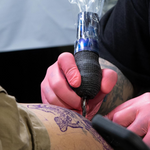


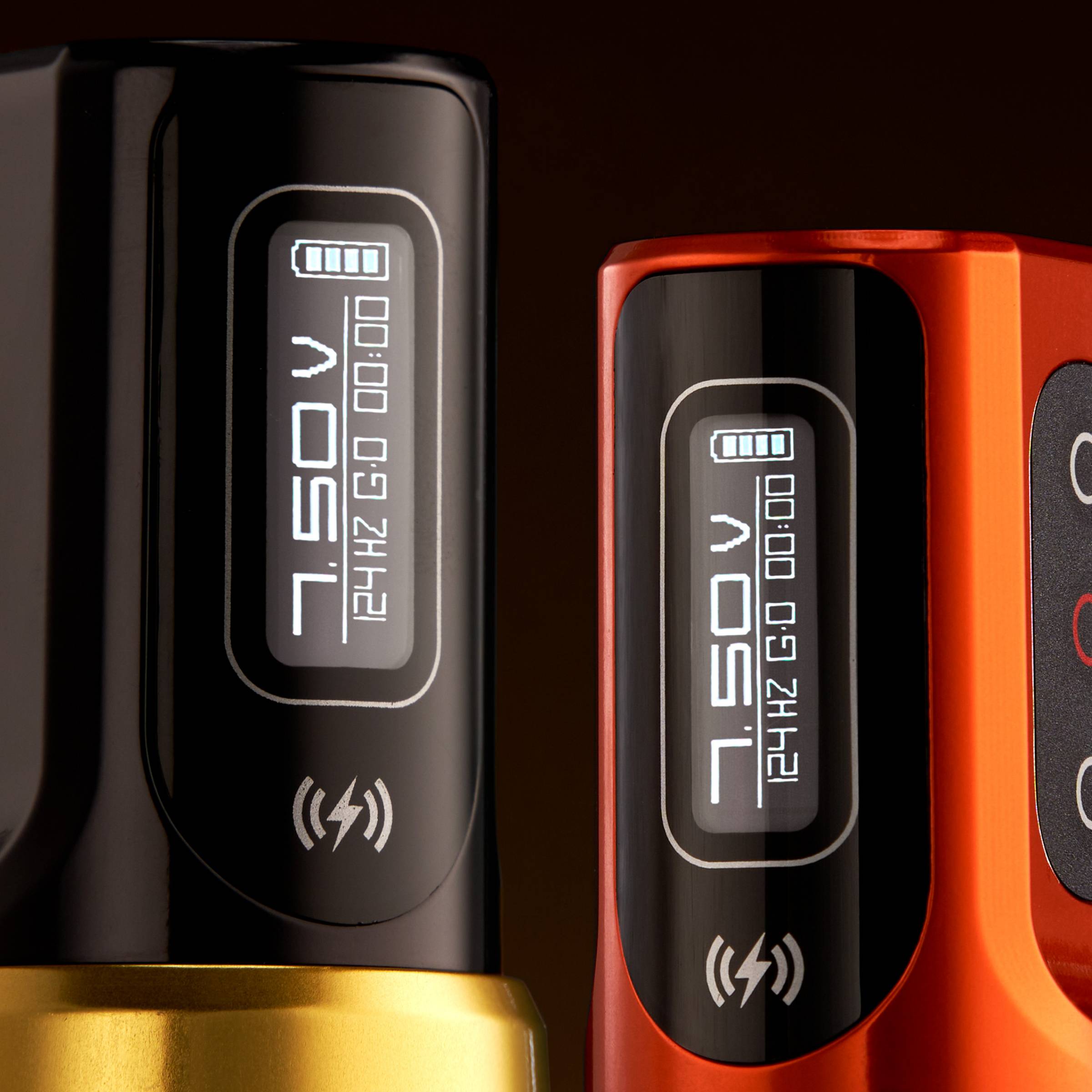
Voltage is one of the most useful controls you have. Once you understand what it actually does, it stops being a guessing game and becomes another tool/setting you can lock in for better results.
In this guide, we'll cover what voltage changes on your machine: how it affects hit, speed, and skin trauma, and how to adjust it without overworking the skin. You'll walk away with a clear understanding of voltage, and how to adjust it to your advantage.
What Voltage Actually Changes on Your Machine

Voltage primarily controls motor speed and power delivery consistency. It does not directly set needle depth, but it influences how aggressively and rapidly the needle interacts with the skin. Depth and “hit” are the result of voltage working together with other factors like stroke length, machine tuning, needle configuration, and hand technique.
But, simply put, it’s all about speed:
- Higher voltage → More needle cycles per second = Machine runs faster.
- Lower voltage → Fewer needle cycles per second = Machine runs slower (softens the impact)
If you want a closer look at the mechanics, our guide on how voltage affects your tattoo machineOpens a new window breaks down the electrical side in more detail.
Most modern rotary machines run well between 6.5V and 10V. Still, the sweet spot (i.e. what works for you) shifts depending on what you're doing.
|
Procedure |
Typical voltage range |
|
Lining |
8V–10.5V |
|
Shading |
6V–8.5V |
|
Packing |
7V–9.5V |
Lining often runs higher because larger needle groupings and setups need the extra speed. Shading usually sits lower for smoother, softer passes. Packing lands somewhere in the middle, and it varies the most depending on how fast you saturate versus how much trauma you want to avoid.
How Voltage Affects Hit, Speed, and Skin Trauma
Ask ten artists what “hit” means and you’ll get ten answers. In practical terms, hit is the felt impact of the machine as it runs: how sharp, soft, or forceful the needle feels entering the skin.
It’s not a single setting. It’s a combo of:
- Motor speed and consistency
- Stroke length and cam design
- Machine give or suspension
- Needle grouping size
- Skin resistance and elasticity
- Hand speed and angle
As we mentioned above, voltage influences hit, but only indirectly. Increasing voltage raises motor speed, which increases cycle frequency. That tends to make the machine feel sharper, more immediate, and more aggressive on the skin. Lower voltage slows the cycle, which generally softens the feel and reduces perceived impact.
But voltage alone doesn’t define hit. Two machines running the same voltage can feel completely different depending on stroke, give, and needle configuration.
Speed vs. perception
Voltage directly affects how fast the machine cycles, but “speed” in practice is a system interaction between machine output and your hand movement. If your hand speed and machine speed are out of sync, the feel of the machine changes — not because voltage changed depth or trauma, but because the work distribution changes.
Skin trauma
Most skin trauma doesn’t come from voltage itself. It comes from how many times the skin is being worked in the same area over time.
That’s the real variable: overlap and repetition.
Skin damage increases when:
- The machine cycles faster than your hand is moving forward
- You’re stacking multiple passes to compensate for slow saturation
- Large groupings are being overworked in a small area
Skin is generally better served when machine speed, hand speed, and needle grouping are aligned so saturation happens efficiently, without unnecessary repetition.
Voltage can contribute indirectly, but only through mismatches — for example:
- High voltage + slow hand speed → overworking the same area
- Low voltage + large mags → dragging, repeated passes, irritation
Neither is “good” or “bad” in isolation. It’s about whether the system is balanced.
How to Adjust Your Voltage Without Overworking Skin

Treat voltage like a fine-tuning dial, not a power switch. Small moves make a real difference, so adjust in steps of 0.2V to 0.5V instead of jumping a full volt at a time.
Start with these baselines, then tune from there (and remember, these are baselines: you’ll find your ideal range or voltage setting through practice and experience):
- Fine line and detail: 7V–8.5V
- Black and grey shading: 6.5V–8V
- Color packing: 7.5V–9.5V
- Bold lining and large groupings: 8V–10.5V
Next, match your voltage to your hand speed. A faster hand usually needs higher voltage for clean saturation. A slower hand does better with lower voltage, which helps you avoid overworking the skin.
While you work, watch how the skin responds in real time. Excessive redness, a bruised texture, or excessive weeping are all signs to ease off. These cues tell you more than any number on your power supply.
Also, don't lean on voltage to fix saturation problems. When color isn't packing the way you want, adjust the things that actually control it:
- your needle grouping
- your hand pressure and stretch
- your pass count and layering strategy
If you're rethinking your setup for each stage, our breakdown of the best machines for lining, shading, and color packingOpens a new window can help you match the tool to the task.
Finally, reassess your voltage when you switch procedures, like moving from lining to shading to packing. You don't need to chase it mid-stroke. The goal is clean, efficient work without adding passes, not the highest number your machine can hit.
Build Your Confidence
Confidence with voltage comes from reps, attention, and a machine you can trust to hold a steady cycle. Set your baseline, make small moves, and let the skin tell you when to ease off. Do that consistently, and your work gets cleaner without extra effort.
Ready to feel that consistency for yourself? Explore the FK Irons machine lineupOpens a new window and find the one that moves with your hand.