
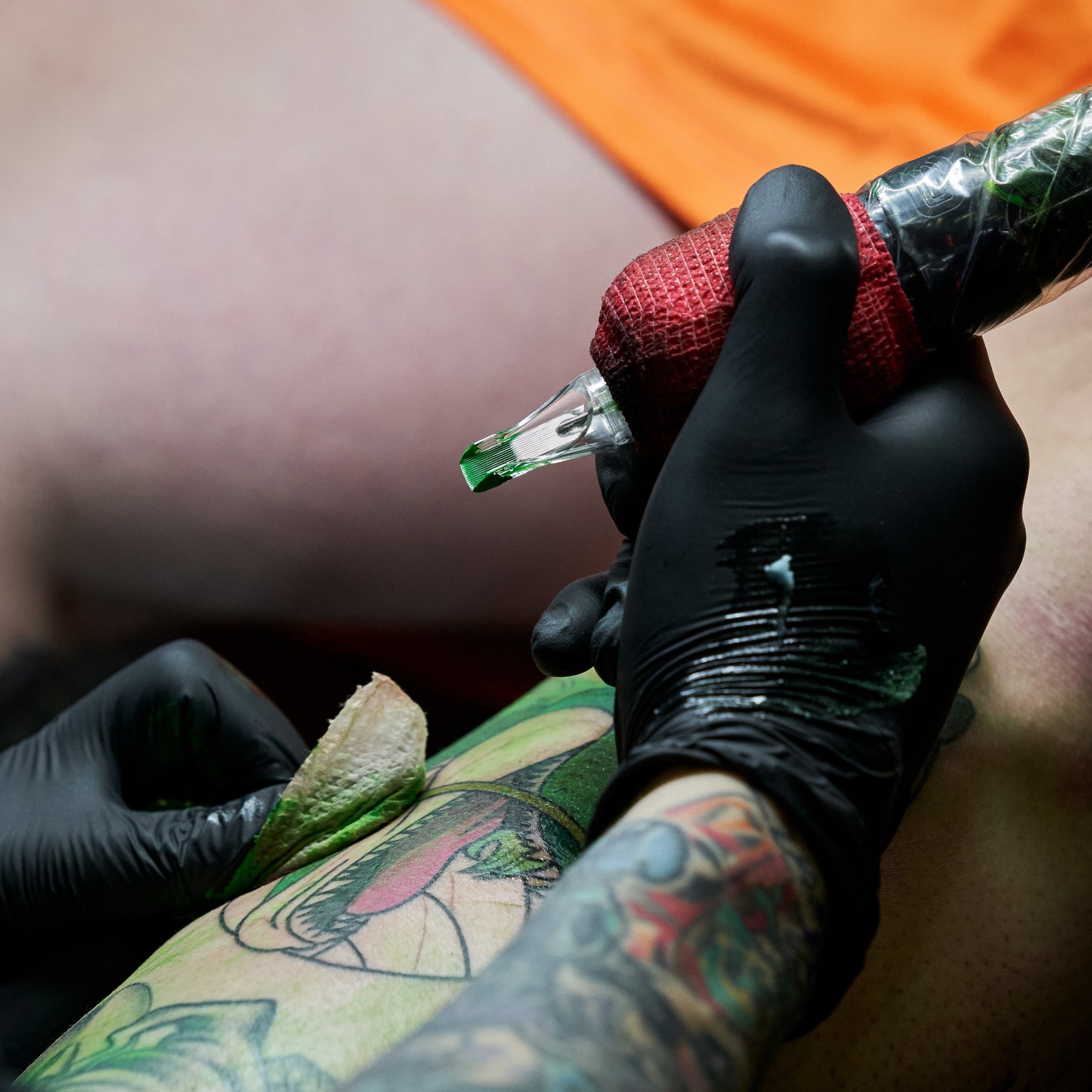
Not every tattoo needle cartridge puts the same demand on your machine. In fact, the demand changes drastically from cartridge to cartridge.
Needle count, diameter, taper, grouping tightness, and membrane tension all affect how a cartridge moves and feels under load.
Understanding those variables takes the confusion out of your setup. This guide breaks down how different needle groupings affect resistance, where voltage and stroke come in, and how to adjust your machine as you swap cartridges.
Start With the Needle, Not the Voltage
The voltage on your machine only tells part of the story. Voltage affects how fast your machine cycles, but the cartridge determines the resistance it has to work against. For a deeper dive, read How to Master Your Tattoo Machine VoltageOpens a new window.
- Needle grouping determines how many pins meet the skin and how they’re arranged, while diameter, taper, grouping tightness, and membrane tension can all change how a cartridge feels at the same settings. Two 9RLs, for example, won’t necessarily run the same.
- Stroke length also affects the setup by determining how far the needle travels each cycle and influencing the feel of the hit. Learn more in Tattoo Machine Stroke Length, ExplainedOpens a new window.
That’s why there’s no universal voltage or stroke for any one grouping. Start with a familiar baseline, then adjust based on the cartridge, technique, and feedback from the skin.
For more on changing cartridges mid-session, read our guide to switching between needle groupingsOpens a new window.
Why a 3RL and a 9RL Don’t Run the Same
Take two round liners: a 3RL and a 9RL.
- A 3RL has a smaller contact area and generally moves through the skin with less resistance. But that fine point leaves little room for shaky movement, poor stretch, or an inconsistent angle.
- A 9RL puts more pins to work with each pass. That creates more resistance and demands more from the machine under load. Carry over the exact same technique and settings from the 3RL, and you may feel more drag or hear the machine respond differently.
But needle count still isn’t the whole equation. A tight 9RL made with thicker, shorter-taper needles can feel considerably different from a bugpin 9RL with a long taper.
The configuration tells you the basic architecture, while the full needle build influences how your machine behaves when you tattoo with it.
Look Beyond the Grouping

Needle count is the obvious difference between cartridges, but it isn’t the only one that affects your setup. Diameter, taper, and membrane tension can all change resistance and how a cartridge feels under load.
A standard-diameter mag, for example, may create more resistance than the same grouping built with thinner bugpins. A firmer membrane can also make two otherwise similar cartridges feel different at the same settings.
The takeaway: if a new cartridge feels heavier or behaves differently than expected, don’t assume the grouping alone is responsible—or immediately reach for the voltage.
Match Your Settings to the Grouping
Once you know what you’re pushing, dial in the machine and your hand around it.
- Voltage: Larger groupings generally create more resistance and may need more drive to maintain consistent performance. But more needles don’t automatically mean more voltage. Start with a familiar baseline and make small adjustments based on how the cartridge performs under load.
- Stroke: You don’t need to change stroke every time you change groupings. A versatile fixed stroke can handle plenty of different cartridges. If you use an adjustable-stroke machine, a longer stroke can provide a stronger hit when larger groupings or bold work call for it.
- Hand speed: Match your movement to your machine speed and the mark you’re making. Move too quickly and pigment placement can become weak or inconsistent. Move too slowly at a high setting and you put more needle cycles into the same area.
Read more about the relationship between machine speed and technique in our guide to tattoo machine voltage and skin responseOpens a new window.
Read the Setup, Not Just the Display
Numbers give you a baseline. Performance tells you whether you nailed it.
A dialed-in setup should feel controlled and consistent: steady machine tone, smooth cartridge movement, clean pigment placement, and no unnecessary passes.
If something feels off, don’t bury the problem under more voltage. Check the cartridge, stretch, angle, working depth, pressure, and hand speed, then change one variable at a time.
And remember: voltage affects machine speed, not how deeply you tattoo. Our guide to setting tattoo needle depthOpens a new window breaks down working depth, needle hang, and technique in more detail.
If the machine repeatedly struggles under load across cartridges, the issue may go beyond your settings. Read our guide to tattoo machine torqueOpens a new window to understand how your motor handles resistance
Troubleshoot Before You Turn It Up

When a new grouping feels wrong, work through the setup instead of chasing the problem with voltage.
- Confirm the cartridge. Check the grouping, needle count, diameter, and taper.
- Inspect the cartridge. Make sure the membrane moves freely and nothing is damaged.
- Check the fit. The cartridge should lock securely into the machine without rattling or unwanted movement.
- Read the skin. Stretch and skin density affect how the grouping moves.
- Check your technique. Reassess angle, working depth, pressure, and hand speed.
- Adjust if needed. Make one small machine adjustment, then read the next pass.
The more consistently you troubleshoot this way, the less it feels like troubleshooting. You start recognizing how different cartridges load the machine, how the right setup feels in your hand, and what needs to change before a bad pass tells you.
Know Your Setup
There isn’t one perfect voltage, stroke, or cartridge combo—and there shouldn’t be.
The goal is to know your equipment well enough that switching from a tight liner to a large mag doesn’t turn into guesswork. With experience, you learn the sound of a machine running cleanly, the feel of the right resistance, and when to adjust your settings versus your technique. It becomes second nature.
Explore FK Irons tattoo machinesOpens a new window for pro machines that can handle any configuration you snap into place. Once you understand how your settings and groupings work hand in hand.