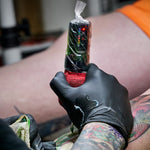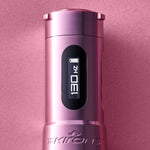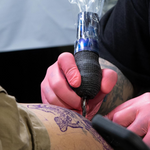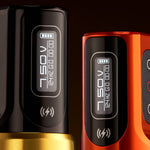

A tattoo machine’s performance isn’t just about how fast the motor runs. When the needle meets resistance from the skin, the motor’s ability to maintain consistent movement becomes critical. That’s where torque comes in.
Torque helps explain why some machines deliver a steady, reliable hit during demanding passes while others may struggle to maintain the same performance. Understanding torque can help you compare machines, fine-tune your setup, and choose a machine that matches your technique.
What Is Torque in a Tattoo Machine?
In the simplest terms, torque is the rotational force produced by a motor.
In a modern tattoo machine, motor torque refers to the force generated by the internal motor to drive the needle mechanism. It plays an important role in how well a machine maintains consistent needle movement when working against resistance, such as when using larger needle groupings or performing demanding passes.
As resistance increases, motor torque becomes a more important factor in maintaining reliable performance.
In practical terms: Torque helps a machine deliver consistent power and needle motion when it matters most — while you’re tattooing.
Why Does Torque Matter in a Tattoo Machine?

During tattooing, your machine isn’t spinning freely in the air. It’s constantly working against a variety of dynamic resistances, including:
- Skin density (which varies across different parts of the body)
- Needle grouping size
- Tattooing speed
- Hand pressure
- Your individual technique
A motor equipped with sufficient torque tackles this resistance effortlessly, helping you maintain consistent needle movement and a stable needle speed throughout every pass. This consistency results in predictable pigment application and reliable performance during longer sessions, especially as you learn how to switch between needle groupings with confidenceOpens a new window for different phases of your tattoo.
Torque vs. Speed vs. Stroke Length
Torque, needle speed, and stroke length all affect tattoo machine performance, but they describe different characteristics.
|
Machine characteristic |
What it means |
What it affects |
|
Torque |
The motor’s rotational force |
The machine’s ability to maintain consistent needle movement when working against resistance |
|
Needle speed |
How quickly the needle cycles through its movement |
The pace of needle delivery and how the machine responds during different techniques |
|
Stroke length |
How far the needle travels during each cycle |
Needle travel, machine feel, and how efficiently pigment is deposited |
Torque vs. Needle Speed
It’s a common misconception to confuse torque with speed, but they serve two very different functions in a tattoo motor:
- Needle Speed: How quickly the needle moves through each up-and-down cycle.
- Torque: The force available to maintain that movement when resistance increases.
A machine can have incredibly high needle speed, but if it lacks torque, the motor will bog down, snag, or stall the moment it faces tough skin. Conversely, a high-torque motor guarantees that the machine maintains consistent needle movement and speed even when working against heavily increased resistance.
Torque vs. Stroke Length
Similarly, torque and stroke length are often lumped together, but they dictate completely different mechanics.
- Stroke Length: The physical distance the needle travels during one complete cycle.
- Torque: The motor’s ability to drive that movement effectively against resistance.
Stroke length determines how far the needle travels, while torque determines how effectively the motor pushes it there. These are entirely independent machine characteristics. This is why two machines with the exact same stroke length can feel and perform drastically differently due to their internal motor design and torque output. Understanding tattoo machine stroke lengthOpens a new window is vital, but pairing the right stroke with the appropriate torque is what makes a machine truly shine.
How Torque Affects Tattoo Machine Feel

Torque isn’t just a metric on a spec sheet. It’s a primary factor contributing to how a machine feels in your hand.
Machines designed with a stronger, punchier torque delivery generally feel:
- More powerful upon skin contact
- Highly consistent under heavy hand pressure
- More capable of effortlessly pushing larger needle configurations (like heavy mags or thick liners)
Machines designed with a smoother, softer torque delivery typically feel:
- More controlled and nuanced
- Highly responsive to your hand movements
- More forgiving for delicate techniques like soft black and gray or building subtle layers
Why Torque Is Especially Important for Rotary Tattoo Machines
While traditional coil setups rely on an electromagnetic pull to move the armature bar, modern rotaries use an electric motor to directly drive the needle movement. If you have recently navigated the transition between coil vs rotary tattoo machinesOpens a new window, you'll quickly recognize that a rotary’s performance relies entirely on its motor.
Because the motor is the heart of a rotary machine, characteristics like torque, speed, efficiency, and consistency play the biggest roles in performance. Understanding torque helps artists realize why different rotary machines with seemingly identical specifications can feel completely unique during a tattoo.
How Torque Affects Different Tattoo Techniques
Your machine's torque output directly influences how effectively you can execute specific styles:
- Lining: Consistent torque helps the machine maintain uninterrupted needle movement during slow, controlled pulls. A stable motor guarantees crisp, saturated, and consistent lines without skipping.
- Color Packing: Torque is heavily relied upon when pushing larger needle groupings like wide magnums. A motor with robust torque will maintain consistent needle movement while saturating the skin with heavy amounts of pigment, without bogging down.
- Shading / Black & Gray: For stippling, whip shading, or soft gradients, smooth and consistent motor performance creates the predictable, steady needle movement required for slower, delicate techniques.
Does Higher Torque Always Mean a Better Tattoo Machine?
No. More torque doesn’t automatically make a tattoo machine better. This is a common trap — assuming that maximizing tattoo machine power is always the best route.
The ideal torque level is subjective. Different artists prefer varying machine characteristics based on their dominant tattoo style, daily techniques, needle choices, and personal preferences. The ultimate goal is finding a balanced machine that delivers the exact right combination of power, control, and consistency for the work you do.
How Can Artists Evaluate Motor Performance?
Looking at a manufacturer's spec sheet won't give you the full picture, as torque specifications can be difficult to compare and are often measured differently across brands.
Motor characteristics must balance speed, torque, heat generation, and intended use. Pushing a motor past its intended capabilities under heavy loads will create excess heat, which is a major factor in why tattoo machine motors fail and how to make yours last longerOpens a new window.
Instead of chasing numbers, evaluate a machine's motor performance based on:
- How consistently it runs during an actual tattoo session.
- How smoothly it responds when met with skin resistance.
- How efficiently it handles your preferred needle configurations.
- How it feels in your hand during your most-used techniques.
Motor Performance Is About Balance
A great tattoo machine isn’t built around torque alone. The motor’s speed, power delivery, efficiency, and response all need to work together to create a consistent feel in the artist’s hand.
Motor design plays a major role in how a machine hits, responds, and performs throughout a session. From there, factors like stroke length, voltage adjustments, ergonomics, and cartridge selection allow artists to fine-tune the machine to match their technique and workflow.
Explore the range of FK Irons tattoo machinesOpens a new window to compare stroke options, power systems, and designs built for different tattooing styles.